
Why South will lead in the global economic tilt
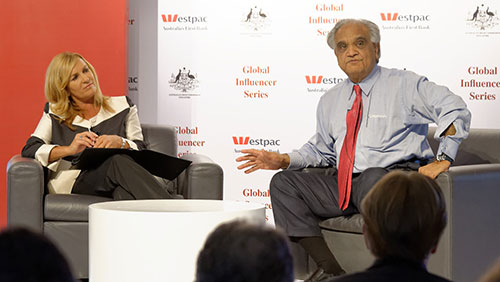 Moderator Ali Moore and Ram Charan at the Global Influencer Series event in Singapore
South-based business leaders have an edge and are out to grab opportunities
by Ram Charan
Published in The Business Times newspaper on 30 April 2014
CLICK HERE to view the photo gallery from the Global Influencer Series event in Singapore >>
The global tilt is an irreversible shift of economic power from North to South: from the U.S., Europe, and Japan in the Northern hemisphere to China, India, Brazil, Indonesia, Singapore and other countries mostly in the Southern hemisphere. The center of gravity for jobs, wealth, and market opportunities is moving, disrupting the world economic order as we have known it.
Business leaders in the South are on the move, tapping into the readily available funding and expertise they need to grow, and scaling up fast to grab once-in-a-lifetime opportunities.
It’s easy for leaders in the North to underestimate their counterparts in the South, attributing their success to government support or low-cost labor, but such a viewpoint is narrow and risky. Successful leaders of the South have enormous energy, ambition, and business savvy, and they are aiming to compete everywhere on the planet.
In some ways business leaders in the South have an edge:
They are a product of scarcity. Improvising and working on very tight margins is second nature. They are fiercely focused on operations, because they know that’s how money is made or lost. Sunil Mittal, founder and CEO of Bharti Airtel, the fourth largest telecom company in the world, began his work life doing the grunt work of sales and distribution. His customers always overpowered him and controlled the pricing, and his meager budget relegated him to riding in the backs of trucks and crowded trains. The discipline of tight margins never left him.
They think large-scale. South-based leaders are living through huge changes in their home countries. An American company might think 4 percent revenue growth is acceptable; a Southern company thinks 20 percent is normal. Right from the start, CEO Zhang Ruimin of China’s Haier Group set his sights beyond China. By innovating, operating efficiently, and exploiting market niches, Zhang has confronted well-established manufacturers of the North on their own territory and used his success there as leverage to win in the global game.
They learn fast. These leaders tap the advice of investment bankers and consultants, many from the North, to identify the best opportunities, and they use partnerships, joint ventures, licensing deals, and acquisitions—whatever it takes— to establish themselves in a market or industry and scale up quickly. Indian infrastructure company GMR, which built the Indira Gandhi International Airport in Delhi, knew virtually nothing about building or running airports when it made a successful venture into that business. Its leaders studied the business intently and met with service providers, cargo companies, duty-free operators, vendors, and architects worldwide to learn what they could.
They move fast. These leaders are energized by the opportunities they see before them, and they are decisive. As head of Brazilian beer company AmBev, Carlos Brito had a voracious appetite for growth. He went on a tear of expansion in Latin America, then in 2004 undertook a merger with Belgium-based Interbrew. Although the European company was bigger, the Brazilian leader ran the combined company. In 2008 he was ready to take yet another big bite, making a surprise purchase of Anheuser-Busch, to create AB Inbev, the world’s largest brewer. Last year, regulators approved his purchase of Mexican-based brewer Grupo Modelo.
Don’t get me wrong; I’m not saying that the tilted world belongs exclusively to the South. The challenge is to understand the competition and adapt how you run your business. In 2012 Procter & Gamble moved its headquarters for personal care from Cincinnati to Singapore, and GE posted a vice chairman in Hong Kong for the first time ever. As Keith Sherin, GE’s chief financial officer, explained, “This is where the growth is. We are shifting our center of gravity to emerging markets.” Winning in the global tilt starts with seeing its reality.
The author is a world-renowned business adviser to CEOs and boards, and a New York Times best-selling author. His latest book is ‘Global Tilt: Leading Your Business Through the Great Economic Power Shift’. Ram visited Singapore to present at the Australian High Commission on behalf of Westpac Banking Corporation.