
Address by High Commissioner Philip Green at SIM / University of Sydney
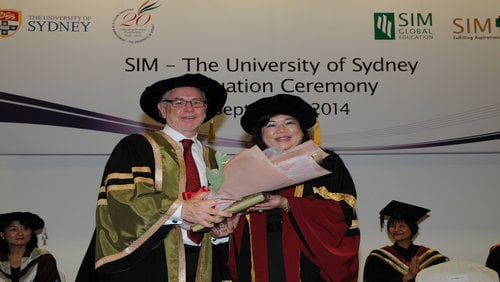
I feel very privileged, as well as pleased, to address your graduation ceremony. These are significant occasions.
Formal, and yet happy….. … a rite of passage, a watershed in your lives... one that should be the source of pride...and one to mark and celebrate, and later remember with fondness.
The ceremony is a celebration of your academic effort and achievement. That is, rightly, our focus today, and I want to touch on some dynamics that will, I think, impact on your future. But before I do that, today is also an opportunity to recall other milestones.
First, this year marks the fiftieth year of SIM.
As those of us in Singapore know well, that means that SIM is older, albeit only one year older, than Singapore itself.
SIM educated young Singaporeans through the early years of Singapore’s development.
It has had to adapt to a changing world, a changing education landscape in order to provide Singaporeans with a quality tertiary education.
It has been a part of the remarkable transformation of Singapore – the creation of a modern wonder.
I congratulate SIM on its part in the greater Singapore success story. It has been a good fifty years.
Second, this year marks the twentieth anniversary of the partnership between SIM and the University of Sydney.
For two decades, SIM and the University of Sydney have collaborated to deliver a first class nursing program here in Singapore.
And in doing so, they have played an integral role in the development of Singapore’s world leading health system.
They have also been part of the wider partnership between Australia and Singapore in education.
As Australia’s official representative in Singapore, I congratulate both SIM and the University of Sydney for contributing to one of the key strengths of our bilateral links.
I want to talk briefly about another key part of the Australia-Singapore partnership in education – the Colombo Plan.
For the younger members of today’s audience perhaps I should explain that the Colombo Plan welcomed to Australia thousands of students from across Asia and Singapore at a formative time in this nation’s and this region’s development.
Today, many of these former students are eminent leaders of this country. Amongst them we have Cabinet Ministers, Permanent Secretaries, business leaders and Professors.
It is not for me to tell you about how the Colombo Plan contributed to Singapore’s success.
But what I can tell you is what it did for Australia.
The Australia you see today is proudly multicultural.
It is a society that has been enriched by people from not only throughout Asia but also from Europe, Africa and the Americas.
But it was not always the case.
When Colombo Plan students first arrived in Australia in the late 1950s, Australia was a predominantly white and culturally homogenous country.
For the Aussies they studied with, the Colombo Plan students were often the first people of different cultures or language backgrounds they had ever met.
For many, the Colombo Plan Scholars were these young Australians first introduction to Asia.
They enriched their student experience because of this.
And helped bring Australia and Singapore closer together.
In Australia we treasure that.
That is one reason why the Australian Government has now developed the New Colombo Plan – an initiative that reverses the original Colombo Plan and brings Australians – thousands of them per year – to study in Asia.
The idea is for these young Australians – whether they are nurses, lawyers, doctors or arts students – to immerse themselves in Asia and Asian culture.
To experience firsthand the economic transformation of Asia and its society.
To learn from the experience and expertise of leading educators and professionals in the Asian region.
And to make lasting connections with other young people in this region.
Singapore was one of the four pilot locations chosen for the New Colombo Plan.
I think this is telling.
Our government and our universities recognise the depth of knowledge and experience Singapore has.
And they recognise the importance of both Australia and Singapore sharing our experiences and our knowledge as we face many common challenges.
We see the New Colombo Plan as the latest phase in the long and deepening partnership between Australia and Singapore in education.
But I didn’t come to talk to you about education today – or indeed history.
I want to use the rest of this address to draw to your attention two key dynamics in Asia that will impact on your professional lives.
First, the rise of Asia. The Asian region is undergoing the most significant economic transformation of our time – the tectonic shift of economic weight from Europe and North America to our region.
This is a phenomenon with global impact and lasting importance.
Asia is the world’s most populous continent, with 4.3 billion people, or 60 per cent of the planet’s population.
For much of our lives, Asia has been densely populated, but many countries, have lacked economic development.
A combination of factors - good demographics, increasing workforce productivity and growing investment, has given rise to the most important global dynamic of our time – the economic rise of Asia.
For example, Asia is set to produce more than Europe and North America combined within the decade to 2020.
And by 2025, the region as a whole is expected to account for almost half of the world’s output.
But the most compelling element of the Asian economic growth story for me is about the rise of the middle class.
Between now and 2030, Asia’s middle class is anticipated to grow six fold.
Nothing comparable will happen in any other region. In Africa and the Middle East, the middle class will grow, but only by two and a half times; Latin America only by one and a half times; and the middle class in Europe and North America will be static.
So while Asia is already the world’s most populous region, it is now set to become the world’s most significant economic zone, the most significant consumption zone, and home to the majority of the world’s middle class.
And with this growing middle class will be an increased demand for high quality services – not least health services.
For example, according to research by Morgan Stanley, consumer spending on healthcare in India to 2025 is forecast to grow at annual rate of 9 percent and in China at 11 percent.
In dollar terms, the Indian health care market is estimated to grow to touch US$158 billion in 2017 – up from US$78.6 billion in 2012.
That is quite striking.
And while the growth in China and India will be on a scale of its own, that growth, that increased demand, will be replicated across the Asian region.
As people’s incomes increase, they want to access a better quality of life – foremost in their minds is ensuring that their family has access to quality services.
Highly trained and qualified nurses such as you will be in increasing demand across the Asian region – particularly as many countries already face a nursing shortage.
In Indonesia for example there are only 14 nurses for every 10,000 people. For Myanmar there are 10 nurses for every 10,000 and in Cambodia only 8.
As these economies and their populations grow, the demand for more health professionals will only increase.
So too will the demand for experienced nursing educators to train the needed numbers of nurses, midwives, doctors and surgeons.
So you and your skills are going to be in high demand.
But there is a second dynamic that will also affect you and your working lives.
In some key Asian economies – and notably in the mega-states of Japan and China – as well as Singapore populations will be aging substantially over the next generation.
In fact, the population of people in Asia and the Pacific aged over 60 will triple between 2010 and 2050, reaching close to 1.3 billion people.
And experts tell us that Asia’s share of those aged 65 and above in the world’s population exceeded 50 per cent in 2000 – this is projected to grow to more than 60 per cent by 2050.
Further complicating this challenge is that ageing patterns across Asia are quite diverse.
It is true that for much of South East Asia, the issue of an ageing population is not apparent. Countries such as Vietnam, India, the Philippines and Indonesia all have relatively young populations.
But for Australia and Singapore, an ageing population is already part of our reality.
It is not a coincidence that health and ageing were key themes in Singapore’s budget this year. Nor that the government has specifically sought to ensure that Singapore’s “Pioneer Generation” have access to quality and affordable health care.
Nor is it a coincidence that Australia is currently in a debate about whether our health system is sustainable and if not, how best to make it so.
How ageing will impact will impact on our economies – and whether our ageing population will impede our ability to take advantage of the Asian growth story is a key policy challenge for both Australia and Singapore.
It is a challenge for health professionals like you but has economic ramifications as well.
For example, as life expectancies increase thanks to the wonders of medical science, how can we ensure that our citizens have enough savings to support them through retirement?
How do we ensure that our citizens have access to world class health care while also ensuring that costs do not rise to unsustainable levels?
And what programs can we put into place to ensure that older members of our society remain productively employed as possible?
These are all complex economic and social issues that both Australia and Singapore – and indeed much of the region - face.
Exactly how these dynamics will affect you and your working lives, I cannot foretell; but I promise you this – these major trends will affect your careers and your lives in real, perhaps profound (if not yet identifiable) ways.
These are issues Singaporeans and Australians can face together and help solve by sharing our knowledge, expertise and indeed, mistakes.
Graduands,
You have benefited from the twin Australian and Singaporean perspectives on health policy, primary care and professional standards.
And this rich educational experience will stand you in good stead to help both our societies and our governments manage the challenges of our changing demographics and healthcare needs.
You all have a part to play in this – and the skills you have worked hard to attain bring not only economic opportunity but also the chance – some would say an obligation – to contribute.
You will have opportunities not only to make good lives for yourselves – you will have opportunities to help others, to contribute to a better community and a strong and prosperous region.
Graduands, I celebrate your journey to this point of graduation today.
But I celebrate the part that others have played in it too.
To those here accompanying this graduating class – the parents, grandparents, aunts and uncles, brothers, sisters, husbands, wives, partners, children and friends –today is an important day for you too.
It is a mark of the support you have shown to the student in your life.
Many of you will have nurtured and supported them financially, logistically, emotionally.
Some of you may have made personal sacrifices to do so.
A university education is a transformative experience, but it is not always plain sailing. The people around students make all the difference. Their contribution is crucial.
So, to all of you who have supported graduates, I offer my congratulations as well. I hope you will take time today to reflect on what you have each provided and what you have each achieved.
To today’s graduates, the future lies before you.
There will be surprises, good and bad.
You will need judgement, courage and resilience.
I have talked almost exclusively about your professional lives. They are important – but don’t forget that a fulfilling personal life goes hand in hand with a successful professional life.
With those words, I wish you all every success in an era of prosperity, challenge and change in Asia – a period of change, in which you now have skills well suited for your, and your community’s, future.
Thank you.